In particle, antimatter is a material composed of antiparticles, which have the same mass as particles of ordinary matter, but opposite charges lepton number and baryon number. Collisions between particles and antiparticles lead to the annihilation of both, giving rise to variable proportions of intense photons(gamma rays) neutrinos and less massive particle–antiparticle pairs. The total consequence of annihilation is a release of energy available for work, proportional to the total matter and antimatter mass, in accord with the mass energy equivalence equation, E = mc2
antimatter had opposite charge, opposite spin opposite configuration of the sub particles that made it up.antimatter had equal mass as matter.
when universe started expanding it was so dense at the starting point that antimatter fall into the singularity and leftover matter was thrown in the infinity. antimatter that fell in the density of space time appears as in another parallel universe. matter that was thrown became a part of this expanding universe.
But not all antimatter got sucked in that dense soup of distorted space time. with passage of few seconds universe becomes less dense and antimatter no more fall into conical singularity and annihilated with matter formed after the big bang. but still after this annihilation for every billion of antiparticle there was billion+1 particle that was a big difference on a large scale as big as our cosmos and was really important for the formation of expanding universe. this was because most of matter was conserved as its proportionality with antimatter was much more.
although big bang created symmetry by creating equal amount of matter and antimatter but due to infinite gravitational force just after the big bang few proportion of antimatter was absorbed and not all antimatter was sucked in because that infinite amount of gravity tends to happen for few microseconds that was not sufficient to capture all of the virtual particles.
Physicists measure the loss of dark matter since the birth of the universe
The discrepancy between the cosmological parameters in the modern Universe and the Universe shortly after the Big Bang can be explained by the fact that the proportion of dark matter has decreased. The authors of the study could calculate how much dark matter could have been lost and what the corresponding size of the unstable component would be. Researchers may explore how quickly this unstable part decays and say if dark matter is still disintegrating.
Russian scientists have discovered that the proportion of unstable particles in the composition of dark matter in the days immediately following the Big Bang was no more than 2 percent to 5 percent. Their study has been published in Physical Review D.
“The discrepancy between the cosmological parameters in the modern universe and the universe shortly after the Big Bang can be explained by the fact that the proportion of dark matter has decreased. We have now, for the first time, been able to calculate how much dark matter could have been lost, and what the corresponding size of the unstable component would be,” says co-author Igor Tkachev of the Department of Experimental Physics at INR.
Astronomers first suspected that there was a large proportion of hidden mass in the universe back in the 1930s, when Fritz Zwicky discovered “peculiarities” in a cluster of galaxies in the constellation Coma Berenices—the galaxies moved as if they were under the effect of gravity from an unseen source. This hidden mass, which is only deduced from its gravitational effect, was given the name dark matter. According to data from the Planck space telescope, the proportion of dark matter in the universe is 26.8 percent; the rest is “ordinary” matter (4.9 percent) and dark energy (68.3 percent).
The nature of dark matter remains unknown. However, its properties could potentially help scientists to solve a problem that arose after studying observations from the Planck telescope. This device accurately measured the fluctuations in the temperature of the cosmic microwave background radiation—the “echo” of the Big Bang. By measuring these fluctuations, the researchers were able to calculate key cosmological parameters using observations of the universe in the recombination era—approximately 300,000 years after the Big Bang.
However, when researchers directly measured the speed of the expansion of galaxies in the modern universe, it turned out that some of these parameters varied significantly—namely the Hubble parameter, which describes the rate of expansion of the universe, and also the parameter associated with the number of galaxies in clusters. “This variance was significantly more than margins of error and systematic errors known to us. Therefore, we are either dealing with some kind of unknown error, or the composition of the ancient universe is considerably different to the modern universe,” says Tkachev.
The concentration of the unstable component of dark matter F against the speed of expansion of non-gravitationally bound objects (proportional to the age of the Universe) when examining various combinations of Planck data for several different cosmological phenomena. Credit: MIPT
The discrepancy can be explained by the decaying dark matter (DDM) hypothesis, which states that in the early universe, there was more dark matter, but then part of it decayed.
“Let us imagine that dark matter consists of several components, as in ordinary matter (protons, electrons, neutrons, neutrinos, photons). And one component consists of unstable particles with a rather long lifespan. In the era of the formation of hydrogen, hundreds of thousands of years after the Big Bang, they are still in the universe, but by now (billions of years later), they have disappeared, having decayed into neutrinos or hypothetical relativistic particles. In that case, the amount of dark matter in the era of hydrogen formation and today will be different,” says lead author Dmitry Gorbunov, a professor at MIPT and staff member at INR.
The authors of the study analyzed Planck data and compared them with the DDM model and the standard ΛCDM (Lambda-cold dark matter) model with stable dark matter. The comparison showed that the DDM model is more consistent with the observational data. However, the researchers found that the effect of gravitational lensing (the distortion of cosmic microwave background radiation by a gravitational field) greatly limits the proportion of decaying dark matter in the DDM model.
Using data from observations of various cosmological effects, the researchers were able to give an estimate of the relative concentration of the decaying components of dark matter in the region of 2 percent to 5 percent.
“This means that in today’s universe, there is 5 percent less dark matter than in the recombination era. We are not currently able to say how quickly this unstable part decayed; dark matter may still be disintegrating even now, although that would be a different and considerably more complex model,” says Tkachev.
A gravitationalsingularity or space-time singularity is a location in space-time where the gravitational field of a celestial body becomes infinite in a way that does not depend on the coordinate system. The quantities used to measure gravitational field strength are the scalar invariant curvatures of space-time, which includes a measure of the density of matter. Since such quantities become infinite within the singularity, the laws of normal space-time could not exist. A type of singularity predicted by general relativity is inside a black hole: any star collapsing beyond a certain point (the Schwarzschild radius) would form a black hole, inside which a singularity (covered by an event horizon) would be formed.The Penrose–Hawking singularity theorems define a singularity to have geodesics that cannot be extended in a smooth manner.The termination of such a geodesic is considered to be the singularity. According to modern general relativity, the initial state of the universe, at the beginning of the Big Bang, was a singularity.Both general relativity and quantum mechanics break down in describing the earliest moments of the Big Bang,but in general, quantum mechanics does not permit particles to inhabit a space smaller than their wavelengths.
Types
There are different types of singularities, each with different physical features which have characteristics relevant to the theories in which they originally emerged from, such as the different shape of the singularities, conical and curved. They have also been hypothesized to occur without Event Horizons, structures which delineate, one space-time section from another in which events cannot affect past the horizon, these are called naked.
cone: space-time looks like a cone around this point, where the singularity is located at the tip of the cone.
curvature:e. In coordinate systems convenient for working in regions far away from the black hole, a part of the metric becomes infinite at the event horizon. However, space-time at the event horizon is regular.
More generally, a space-time is considered singular if it is geodesically incomplete meaning that there are freely-falling particles whose motion cannot be determined beyond a finite time, being after the point of reaching the singularity. For example, any observer inside the event horizon of a non-rotating black hole would fall into its center within a finite period of time. The classical version of the big bang cosmological model of the universe contains a causal singularity at the start of time (t=0), where all time-like geodesics have no extensions into the past. Extrapolating backward to this hypothetical time 0 results in a universe with all spatial dimensions of size zero, infinite density, infinite temperature, and infinite space-time curvature.
geodesics in space time
In general relativity, a geodesic generalizes the notion of a “straight line” to curved space time. Importantly, the world line of a particle free from all external, non-gravitational force, is a particular type of geodesic. In other words, a freely moving or falling particle always moves along a geodesic.
In general relativity, gravity can be regarded as not a force but a consequence of a curved spacetime geometry where the source of curvature is the stress energy tensor (representing matter, for instance). Thus, for example, the path of a planet orbiting around a star is the projection of a geodesic of the curved 4-D spacetime geometry around the star onto 3-D space.
black holes
A black hole is a region of space time exhibiting such strong gravitational effects that nothing—not even particles and electromagnetic radiation such as light—can escape from inside it. The theory of general relativity predicts that a sufficiently compact mass can deform spacetime to form a black hole. The boundary of the region from which no escape is possible is called the event horizon. Although the event horizon has an enormous effect on the fate and circumstances of an object crossing it, no locally detectable features appear to be observed. In many ways a black hole acts like an ideal black body as it reflects no light. Moreover, quantum theory in general space time predicts that event horizons emit hawking radiation, with the same spectrum as a black body of a temperature inversely proportional to its mass. This temperature is on the order of billionths of a kelvin for black holes of stellar mass making it essentially impossible to observe.
Black holes of stellar mass are expected to form when very massive stars collapse at the end of their life cycle. After a black hole has formed, it can continue to grow by absorbing mass from its surroundings. By absorbing other stars and merging with other black holes, supermassive blackholes of millions of solar masses may form. There is general consensus that supermassive black holes exist in the centers of most galaxies.
if a star is denser than GM/C2 R≥1 then we see that no photon can ever leave the star since to do so requires more energy than its energy “hv”. the redshift would in effect, have then stretched the photons wavelength to infinity. a star of this type cannot radiate so would be invisible- A BLACK HOLE IN SPACE.
schwarzschild radius
schwarzschild radius
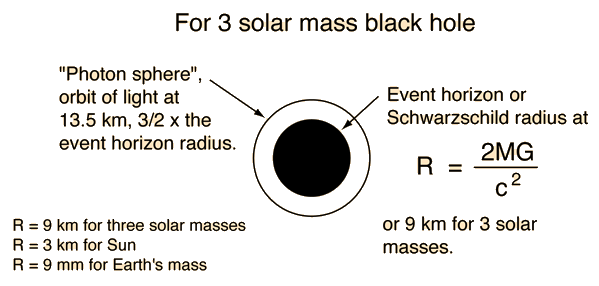
Rs=2GM/c2
the body is a black hole if all its mass is within the size of this radius. the boundary of a blackhole is called an event horizon. the escape speed form the black hole is equal to the speed of light c at the schwarzschild radius, hence nothing at at all can ever leave a black hole. for the stars having sun’s mass, Rs is 3km, a quarter of a million times smaller than the sun’s present radius. A black hole that is the member of a double star system will reveal its presence by its gravitational pull on the other star; the two star circle each other. In addition, the intense gravitational field of the black hole will attract matter from the other star, which will be compressed and heated to such high temperatures that x-rays will be emitted profusely. One of a number of invisible objects that astronomers believe on this basis to be black holes is known as cygnus-X1. The region around black hole that emits x-rays should extend outwards for several hundred kilometers.
The no hair theorem states that, once it achieves a stable condition after formation, a black hole has only three independent physical properties:Mass, charge and angular momentum .Any two black holes that share the same values for these properties, or parameters, are indistinguishable according to classical (i.e. non-quantum) mechanics.
These properties are special because they are visible from outside a black hole. For example, a charged black hole repels other like charges just like any other charged object. Similarly, the total mass inside a sphere containing a black hole can be found by using the gravitational analog of gauss law, the ADM mass, far away from the black hole.Likewise, the angular momentum can be measured from far away using frame dragging by the Gravitomagnetic field.When an object falls into a black hole, any information about the shape of the object or distribution of charge on it is evenly distributed along the horizon of the black hole, and is lost to outside observers. The behavior of the horizon in this situation is a dissipative system that is closely analogous to that of a conductive stretchy membrane with friction and electrical resistence- the membrane paradigm. This is different from other field such as electromagnetism, which do not have any friction or resistivity at the microscopic level, because they are time reversable. Because a black hole eventually achieves a stable state with only three parameters, there is no way to avoid losing information about the initial conditions: the gravitational and electric fields of a black hole give very little information about what went in. The information that is lost includes every quantity that cannot be measured far away from the black hole horizon, including approximately conserved quantum numbers such as the totalbaryon numbers and lepton number. This behavior is so puzzling that it has been called the black hole information loss paradox.
we all know that iron is magnetic as it gets attracted by magnet but copper is not. but when current is passed through copper or any other metal it behaves like an electromagnet. how does this work? why metals behaves like a magnet when current is passed through them?
actually its the consequence of special theory of relativity given by einstein. absolute relativity says that time and length are absolute. time for a moving object moves slower than the time moving for an object in respect to the observer. faster anything goes shorter it gets. length gets contracted when it moves close to the speed of light.
length contraction is responsible for electromagnetism.
imagine two copper wire having positive metal ions swimming in free negative electrons. number of electrons is equal to the number of positive ions therefore it is neutral and hence if there was a positive charge nearby it will not feel any force. if there is a current flowing through the first conductor electrons start moving. now in wire electrons are moving, whereas, in other wire both positive and negative charges are at rest. let us take velocity of electrons as ‘v’. now moving electrons in first wire have the velocity of ‘2v’. using relativity, electrons in the first wire gets contracted and became more dense. now first wire has more electrons than the second wire in frame of reference of the observer. in the second wire positive charges are tends to move thus contracting and getting dense in first wire’s frame of reference. and due to this both gets attracted which we say that first wire gets magnetized.
if you have any queries or need some more information about the topic let me know through the comments or you can contact me through Gmail.
Among an assortment of things (whether they be nuts, sedimentary deposits, or other objects of varying sizes), larger pieces rise to the top over time in spite of their greater gravitas, while smaller objects tend to sink lower in the pile over time. Perhaps the small stuff is trickling through cracks. convection currents may also play a role, as might condensation of smaller particles. All of these possibilities and a few more probably contribute to the Brazil nut effect, but no one knows which ones, or to what extent, so no successful computer simulations of the phenomenon have been made.
Not only nut manufacturers, but also physicists, astronomers and geologists would all benefit from an understanding of the effect.
CHEERIOS EFFECT
You may or may not have pondered why your breakfast cereal tends to clump together or cling to the sides of a bowl of milk. Dubbed the cheerios effect by scientists, this clumping phenomenon applies to anything that floats, including fizzy soda bubbles and hair particles in water after a morning shave.
Dominic Vella, a graduate student now at Cambridge University, and Lakshminarayanan Mahadevan, a mathematician from Harvard University, were the first to explain the effect in terms of simple physics, which they did in a 2005 paper. The Cheerios Effect, they proved, results from the geometry of a liquid’s surface.
surface tension makes the milk’s surface cave in slightly in the middle of the bowl. Because water molecules in the milk are attracted to glass, the milk’s surface curves upward around the bowl’s edge. For this reason, pieces of the cereal near the edge float upward along this curve, appearing as if they’re clinging to the edge.
Also because of surface tension, cereal floating in the middle of your bowl dents the milk’s surface, creating a dip in it. When two pieces of cereal touch, their two dents become one, and, resting in it, they stick together.
STATIC
Static shocks are as mysterious as they are unpleasant. What we know is this: They occur when an excess of either positive or negative charge builds up on the surface of your body, discharging when you touch something and leaving you neutralized. Alternatively, they can occur when static electricity builds up on something else a doorknob, say which you then touch. In that case, you are the excess charge’s exit route.
But why all the buildup? It’s unclear. The common (and probably partly correct) explanation says that when two objects rub together, friction knocks the electrons of the atoms in one of the objects, and these then move onto the second, leaving the first object with an excess of positively charged atoms and giving the second an excess of negative electrons. Both objects (your hair and a wool hat, say) will then be statically charged. But why do electrons flow from one object to the other, instead of moving in both directions?
This has never been satisfactorily explained, and a recent study by Northwestern University researcher Bartosz Grzybowski found that it may not even be the case. As detailed in the June issue of the journal Science, Grzybowski found that patches of both excess positive and excess negative charge exist on statically charged objects. He also found that entire molecules seemed to migrate between objects as they are rubbed together.
1. The brain is more active at night than during the day. Scientists don’t know yet why this is.
2. The higher your IQ, the more you supposedly dream.
3. Facial hair grows faster than any other hair on the body.
4. The nail on the middle finger grows faster than the other fingernails.
5. Fingernails grow nearly four times faster than toenails.
6. The lifespan of a human hair is 3 to 7 years on average.
7. The acid in your stomach is strong enough to dissolve zinc. It doesn’t destroy the stomach because the stomach walls constantly renews itself.
8. Women’s hearts beat faster than men’s.
9. Women blink twice as many times as men do.
10. Women are born better smellers than men and remain better smellers over life.
11. Men burn fat faster than women by a rate of about 50 calories a day.
12. Men get hiccups more often than women.
13. A man has approximately 6.8 liters of blood in the body while women have approximately 5 liters.
14. The largest cell in the body is the female egg and the smallest is the male sperm.
15. During your lifetime, you will produce enough saliva to fill two swimming pools.
16. Babies are born with blue eyes more than any other color. The melanin in their eyes needs time to be fully deposited or to be darkened by ultraviolet light to reveal the baby’s true eye color.
17. Men have erections every hour to hour and a half during sleep. This is because the combination of blood circulation and testosterone production can cause erections during sleep and are a necessary part of REM sleep.
18. After eating too much, your hearing is less sharp.
19. If your saliva cannot dissolve or mix with food, you will not be able to taste that food (try tasting something after drying off your tongue)
one of the most famous equation by einstein is E=mc² which states that energy is equal to mass. energy is taken in joules whereas mass is considered in kilograms. if we have to relate them we have to relate them with some factor. in this equation the factor is square of the speed of light. this is a strong equation that tells anything which has mass has a great source of energy. in non relativistic physics the kinetic energy of the object of mass ‘m’ having a velocity ‘v’ is KE=½mv². but as soon as velocity increases with relative to speed of light equation changes to more complicated term E=mc². but this equation is still incomplete. actually einstein was little bit wrong about predicting the energy of moving object in relativistic terms. he actually predicted the energy of a mass at rest relative to the observer(also known as the proper mass). the actual equation is:
E²=m²c4+p²c²
where ‘p’ is the momentum of a body having mass.
E=mc² itself is a broad concept and describes most of the physics phenomena and mechanism at quantum level. if we take all the mass of the particle in together and compare it with the masses of sum of every single particle mass drops. mass drops due to binding energy of these particles which can be given by E=mc². if we take the under root of energy of masses at motion then we come with negative energies that is with energy of anti matters.
its so amazing that how physics describes the very beauty of the nature…..




 PHYSICS SAGA